
Stranger Than Fiction
April 2025
Making News
by Dean Jobb
The brutal murder of Mr. Trat, a parish priest, shocked residents of Somerset, England. He was ambushed on a highway and his body was mutilated and dismembered. Three men and a woman were executed for the crime and there was so much interest in the case that a special publication was printed—complete with a grisly illustration depicting the “most horrible butchery”—to supply the sordid details.
Sound like a modern-day atrocity ready-made for a true-crime podcast or documentary? Trat’s murder occurred four centuries ago, in 1624, and was reported in one of England’s earliest newspapers. “The journalists who were feeding the early printing presses learned what all journalists have learned,” media historian Mitchell Stephens has noted. “Crime news is prime news.” This month, a roundup of recent nonfiction books that focus on sensational crimes, the crooks, crimefighters and scofflaws who made headlines, and the journalists who put them on the front page.
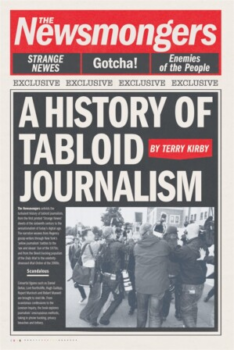 The Newsmongers: A History of Tabloid Journalism (Reaktion Books) is an ambitious book that explores the origins, evolution, and impacts of a form of reporting that brings crime and sensationalism to the forefront. Who better to tell this story of behind the “gotcha” headlines than author Terry Kirby, a journalism professor in London and a former crime reporter for The Independent, an upstart and serious-minded British tabloid that’s now published exclusively online.
As Kirby explains, the term tabloid refers to both a type of newspaper and a style of reporting. Tabloids are smaller than traditional broadsheet newspapers, easier for commuters to read on trains and buses, and offer the short, tightly focused stories essential to their mass-market appeal. “Tabloid,” he adds, “is a state of mind and a method of practice.” At its most extreme, tabloid journalism favors “scandal and sensation over sober facts” and “glorifies crime, trivia and sleaze.” At its best and noblest, it uses its popularity to convey “important information to a wide readership rather than an elite one.” The tabloid journalist’s role, a British editor I worked for in my days as a newspaper reporter noted, is similar to that of a circus barker: “get them into the tent and tell them something they should know.” It’s a formula that made a succession of press barons—from Lord Northcliffe to William Randolph Hearst to Rupert Murdoch—powerful and filthy rich.
Crime reporting has been a staple of tabloid journalism since the days of Daniel Defoe, whose early eighteenth-century exploits included interviewing prison inmates and standing on scaffolds to overhear the last words of executed criminals. The Illustrated Police News, which offered readers exactly that, was one of England’s highest-circulation weeklies in the 1880s. George Orwell once confessed his guilty pleasure was settling into an armchair with a cup of tea to read all about the latest murders. And a New York murder, Kirby notes, inspired perhaps the most famous tabloid headline of all time: “Headless Body in Topless Bar.”
Kirby subjects an industry that feasts on the mistakes and wrongdoings of others to a dose of its own medicine, exposing the failings and abuses of a tabloid media that’s often more interested in profits and entertainment—and pandering to its audience—than disseminating the truth. Kirby chronicles these excesses, from the New York Sun’s infamous “moon hoax” of the 1830s—the paper claimed that astronomers had spied bat-like humanoids on its surface—to the phone-hacking scandals that forced Murdoch to shutter one of the oldest and most infamous tabloids, The News of the World, in 2011. The paper’s deathblow was a revelation that its newsmongers had callously accessed the voicemail of a murder victim. As fake news, artificial intelligence, and social media trolls pollute today’s news cycle, The Newsmongers is a reminder that the challenges of separating fact from hype and fiction have been with us for centuries.
Laura Fair knew how to grab headlines. In the fall of 1870, on a crowded ferryboat in San Francisco Bay, the 33-year-old former actress and boarding house proprietor calmly approached prominent California lawyer Alexander Crittenden, slipped a pistol from her purse, and shot him dead. Crittenden was with his wife, Clara, and one of their children when he was killed in front of scores of witnesses. It looked like an open-and-shut case. Fair had bought the pistol only days earlier and had followed Crittenden onto the ferry so she could witness his reunion with his wife. He had been married to Clara for more than 30 years but Fair, his mistress for seven years, insisted that she was his real wife.
 The four-week trial that followed was a press sensation, filling newspaper columns across the country with scandalous revelations that challenged Gilded Age notions of morality and respectability. Bestselling author Gary Krist offers a vivid and dramatic retelling of a shocking story of betrayal and murder in Trespassers at the Golden Gate: A True Account of Love, Murder, and Madness in Gilded-Age San Francisco (Crown). “By calling into question fundamental assumptions about the sanctity of the family, the value of reputation, and the range of acceptable expressions of femininity, the case would become profoundly divisive,” he writes. “It would cause rifts and arguments between husbands and wives, provide endless fodder for newspaper editorialists, and inspire paroxysms of indignation among sermonizing clergymen.”
Crittenden was a major figure in California’s early history. He arrived from Kentucky via Texas in 1849, too late to join the rush to the goldfields but in time to become one of the new state’s first legislators. Clara and their brood of children joined him in San Francisco a few years later, once he built a legal practice and made enough money. “You have endured with me poverty and humiliation,” he told her, and “have earned the right now to wealth and honors.” Instead, he subjected her to humiliation and heartache.
The discovery of a rich silver lode—and a rich vein of mining-related legal work—drew him to neighboring Nevada Territory in 1863, where he took a room in Fair’s boarding house. A fellow Southerner in her mid-twenties—two decades younger than Crittenden—she had been married three times, divorced once, and widowed twice. Their affair began almost immediately and it was a year before Fair discovered her new love, who claimed to be a widower, was married. Crittenden performed a juggling act for the next six years, promising Fair he would file for divorce so he could marry her while assuring his wife that rumors of the affair were false. His long campaign of deception and betrayal culminated in the shooting on the San Francisco ferry.
Krist draws on the trial transcript, letters entered as evidence, and trove of other correspondence preserved in archives to tell, in remarkable and compelling detail, the tawdry backstory to the murder. Fair, derided as an “ungovernable woman”—the ultimate slur for any female in those unequal, male-centric times—emerges as a victim not only of her lover’s broken promises, but of the hypocrisy of nineteenth-century society. The letters of the controlling and manipulative Crittenden, meanwhile, were peppered with threats and desperate pleas—more worthy of a lovesick schoolboy than a high-powered lawyer—as he tried to string along both women for as long as he could, oblivious to the endgame that lay ahead.
Trespassers at the Golden Gate is a triumph of historical true crime writing. Krist meticulously recreates how the lives of Fair and Crittenden collided, but he’s also after bigger game. He has explored the rise of Chicago, Los Angeles, and New Orleans in previous books, and this murder case plays out against the backdrop of San Francisco’s meteoric rise from frontier shantytown to “Paris of the Pacific.” Mark Twain, Susan B. Anthony and other A-listers of the Gilded Age are woven into the narrative as the author puts the era’s blatant misogyny and stifling moral codes on trial. Was Fair convicted and hanged? Immerse yourself in this gem of a book to find out.
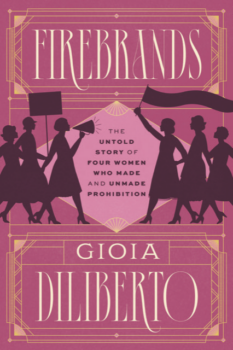 Fast forward a few decades to the Jazz Age. Ella Boole, Mabel Walker Willebrandt, Mary Louise Cecilia “Texas” Guinan, and Pauline Morton Sabin are no longer household names, but in the 1920s these women made news as well as waves for their support of, or opposition to, Prohibition. Biographer and journalist Gioia Diliberto tells their intertwined stories in Firebrands: The Untold Story of Four Women Who Made and Unmade Prohibition (University of Chicago Press), a groundbreaking book that challenges the popular image of the war over booze as an all-male enterprise, a battle between G-Men and underworld Al Capones.
“Their lives evoke one of the biggest, most brutal political clashes of the twentieth century,” Diliberto writes, “and yet they missed history’s last call. Today they are mostly forgotten.” She sets out to correct the historical record and restore the women to their rightful place as pioneering feminists and the first female activists to flex their political clout after women won the right to vote in national elections in 1920. “It is the story of how women fought for power at a particular moment in American life when they had little status and faced rampant sexism at every turn.”
These crusading women included Boole, who campaigned for a ban on booze as leader of the powerful Woman’s Christian Temperance Union—one newspaper dubbed her the “Iron Chancellor of Prohibition”—and fought to keep the country dry long after it became clear that Prohibition was making gangsters rich and doing little to staunch the flow of illegal liquor. Her ally in this fight was Willebrandt, who was in charge of federal enforcement of Prohibition laws—Diliberto calls her “the most powerful woman in America at the time”—and prosecuted bootleggers “with a ferocity that amazed the drinking men in power.” Guinan, a brash former actress who earned the nickname Texas as the star of western movies, openly defied the law and ran some of New York’s most famous and popular speakeasies. “Hello, suckers,” she joked as she welcomed the celebrities, journalists, and crooks who joined her to flout the law. Sabin, the final member of this quartet, was a glamorous Manhattan socialite who decried the corruption and lawlessness created by the “nauseating abuse of political authority” that was Prohibition, and mobilized women from all walks of life—“Sabines,” the press called them—to demand its repeal.
These women—the zealous crusader, the Washington powerbroker, the former movie star, and the wealthy socialite—had one thing in common: “an ambition,” Diliberto writes, “to push the boundaries of society’s norms.” A trove of official documents and personal letters—supplemented by the recollections of grandchildren who are still alive—enable the author to bring each of her characters to life, ensuring these former headliners are no longer lost to history.
————-
Dean Jobb’s latest true crime book A Gentleman and a Thief: The Daring Jewel Heists of a Jazz Age Rogue (Algonquin Books and HarperCollins Canada) tells the incredible story of Arthur Barry, who charmed the elite of 1920s New York while planning some of the most brazen jewel thefts in history. It’s a New York Times Editors’ Choice and a Canadian bestseller. Find him at deanjobb.com.
Copyright © 2025 Dean Jobb